
Why entreprise AI succeeds through the system around the model
Learn how a seven-part AI harness helps enterprises build grounded, controlled and auditable agentic AI systems that work at scale.
Learn how a seven-part AI harness helps enterprises build grounded, controlled and auditable agentic AI systems that work at scale.

Most companies start their AI journey with the wrong question. They ask which model to use. Yet the model is rarely the main reason an AI system fails in production.
The bigger challenge sits around the model. How does the system use trusted data? What does it remember? How does it verify an answer? And can people understand what happened afterwards?
Engineers call this surrounding architecture the AI harness. For enterprises, its design matters more than choosing the latest model.
Three questions quickly reveal whether an AI product is ready for enterprise use:
A more capable model does not solve these questions. They require deliberate system design.
This matters in every part of the organization. AI systems now read, interpret and act on large volumes of information, from customer service and sales to finance, operations, HR and compliance. Enterprises need reliable outputs, controlled access and a clear audit trail. Without these foundations, ambitious AI features remain demonstrations rather than dependable products.
We design the harness as seven connected parts. Each performs a distinct role:
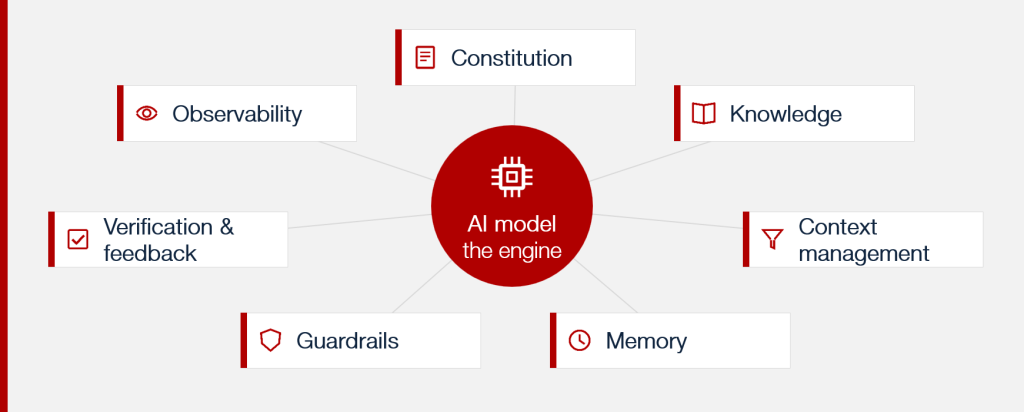
When these parts work together, the underlying model becomes easier to change. If they fail, even a highly capable model cannot make the product dependable.
Principles only matter when they work in a real business context. We applied this seven-part framework to an agentic enterprise platform that supports decisions across several business functions.
That required translating technical concepts into practical controls. Guardrails became rules that compliance teams could recognize. Observability became an audit trail that people could read. Verification focused on business-specific risks, such as misreading a document, misattributing a transaction or identifying an issue too late.
The framework is embedded in an agentic enterprise platform. Instead of asking one general model to do everything, the system coordinates specialist agents, each responsible for a distinct task:
The orchestrator governs the system. It assigns work, manages context and keeps every agent aligned to the same rules. This creates one coherent answer rather than ten disconnected opinions.
This architecture allows an established enterprise platform to extend into agentic AI without lowering the standards clients expect. The result is predictable behavior, a transparent audit trail and outputs that risk and compliance teams can review.
The lesson applies to every business function that relies on AI, from marketing and sales to supply chain, finance and risk management. Models will keep changing. The harness is the durable capability an organization designs and owns.
The strongest enterprise AI products do more than generate impressive answers. They connect models with data, controls, verification and human oversight.
Before selecting another model, ask a more important question: Is the system around it designed for trust, scale and accountability?
Federico Cesconi is an Independent Consultant with a-connect with more than 20 years of experience in machine learning and artificial intelligence. His expertise spans AI strategy, use-case development, machine learning, data protection, governance, and production-ready implementation. With a background in technology, law, and business, he helps organizations apply AI in ways that are practical, effective, and responsible.
Let’s connect

Niki Inglezou
Talent Service Partner Zurich


Carlo Verri
Client Service Partner Zurich

Register for our newsletter to receive curated insights directly to your inbox.