

A U.S. pharmaceutical organization’s sales operation team needed to transition its entire national fleet to a new provider due to performance issues with the existing partner cited by the field teams. What looked like a vendor change on paper quickly became a live operating model transformation.
With 250+ fleet vehicles, multiple vendors, and a sales team that needed to stay on the road, the real challenge was operational continuity.
Over nine months, we helped the organization manage the transition, protect the field team experience, and build a clearer, more scalable fleet operating model, unlocking estimated annualized savings of $300K+ and reclaiming 20–30 operator hours per week through workstream automation.
Our client needed to move its 250+ U.S. field team from three legacy leasing partners to a single new entreprise-led fleet-management partner. The shift happened mid-lifecycle, with vehicles already in market and the field teams relying on them every day.
The real challenge was not simply moving vehicles from one provider to another. It was coordinating a live ecosystem of vendors, processes, and field needs without creating a service gap.
Three legacy leasing vendors, a new fleet-management partner, fuel-card providers, driver-safety partners, and the insurance broker all touched the same driver experience. Vehicle delivery, rentals, fuel access, registration, insurance, safety compliance, finance, and vendor closeout were all connected.
If one handoff failed, the issue would not stay operational for long. A driver without a fuel card, a rental extension, or an updated registration could quickly become a leadership concern.
The client needed more than project coordination. They needed one clear operating layer to manage risk, drive decisions, and keep the field teams moving.
We helped the client frame the work as an operating model transformation, not a vendor swap.
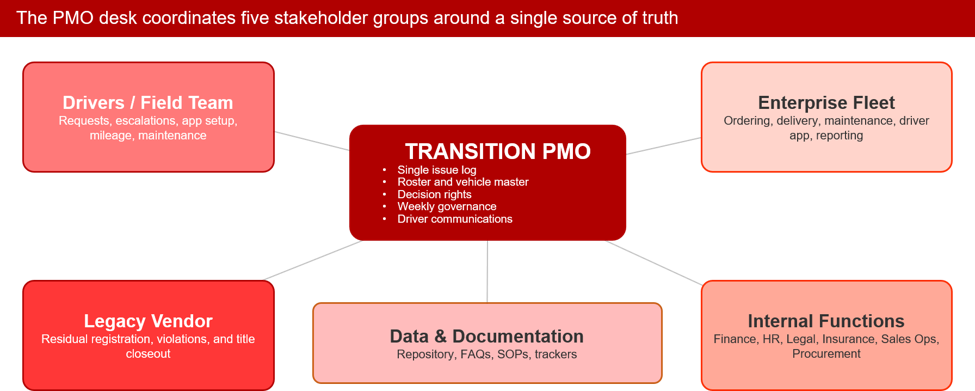
We set up a single-desk PMO as the central coordination point across all active vendor relationships. This created one point of accountability for driver data, vehicle status, vendor progress, open service tickets, spend thresholds, and escalations.
Instead of leaving vendors to coordinate bilaterally, every thread came through one structured operating layer. This helped our client see where decisions were needed, where exceptions were building, and where operational risk could affect the field teams.
We avoided a single “big bang” cutover. Instead, the migration was phased by operational risk.
New hires without vehicles were prioritized first. High-mileage and non-operational vehicles followed. Aged vehicles, rentals, and residual exit activities were then managed in later waves.
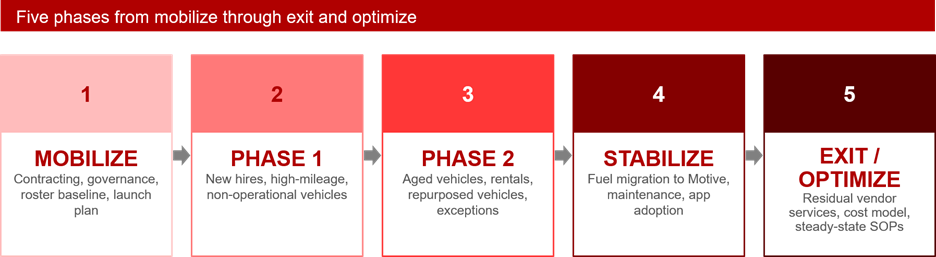
This wave-based approach allowed our client to isolate exceptions, learn from early transitions, and reduce disruption before moving more complex segments.
The operational cutover marked the shift to the new fleet-management partner. The fuel-card migration two-month later followed the same phased logic. Residual services with legacy vendors, such as registration, violations, and title support, were intentionally narrowed over the following months.
To keep the transition moving, six workstreams ran in parallel with a weekly cadence. Each workstream had a clear owner, escalation route, and status feed into the PMO.
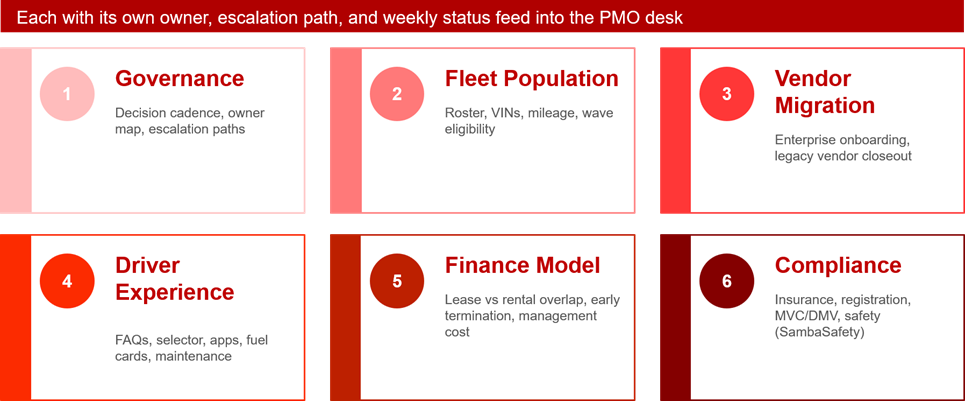
The workstreams covered the operational areas that mattered most to the driver and to the business:
This structure allowed our team to manage cross-workstream issues centrally. For example, a safety flag, a fuel-card activation issue, or a rental extension request could be assessed in the full operational context rather than treated as an isolated vendor issue.
Driver communication was designed to reduce confusion and prevent avoidable tickets.
Each FAQ, wave email, and response template was built to answer the questions drivers were most likely to ask at each phase. The goal was not just to announce change. It was to make the transition easier for the field teams and reduce pressure on the operating team.
This made communication part of the operating model itself.
Our team also focused on what would remain once the transition was complete.
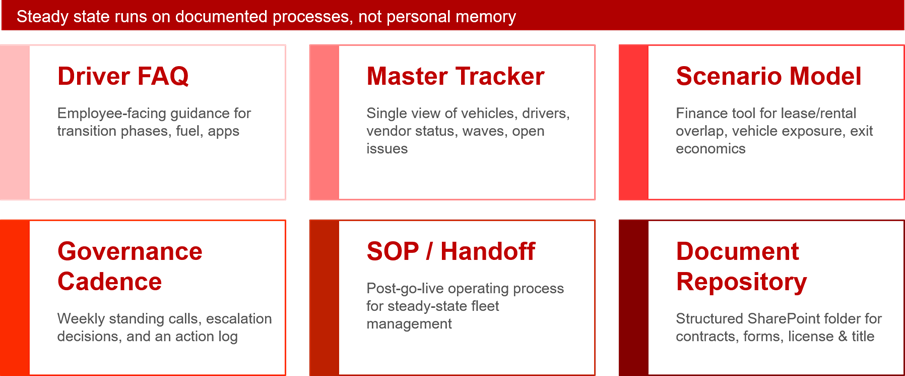
We helped create a set of durable artifacts, including SOPs, trackers, ownership rules, repository structures, and handover materials. These gave the receiving operator a clear way to manage the new model without relying on individual memory.
The handover also included purpose-built AI assistants scoped to specific audiences and workflows. These included a driver-facing FAQ assistant, an internal operations cockpit, and an email-drafting assistant. Together, they turned repeated questions and operating knowledge into a searchable reference layer for the team.
Our client migrated 250+ vehicles into the new fleet operating model without a field-facing service gap.
The transition also reduced the legacy vendor scope from full-fleet responsibility to a defined residual tail across registration, violations, and title support. This gave the client a cleaner vendor model, clearer ownership, and better visibility over remaining obligations.
Finance leadership gained a scenario model that made controllable cost levers visible for the first time. This helped the organization understand the cost of delay, lease overlap, rental drag, and residual exposure.
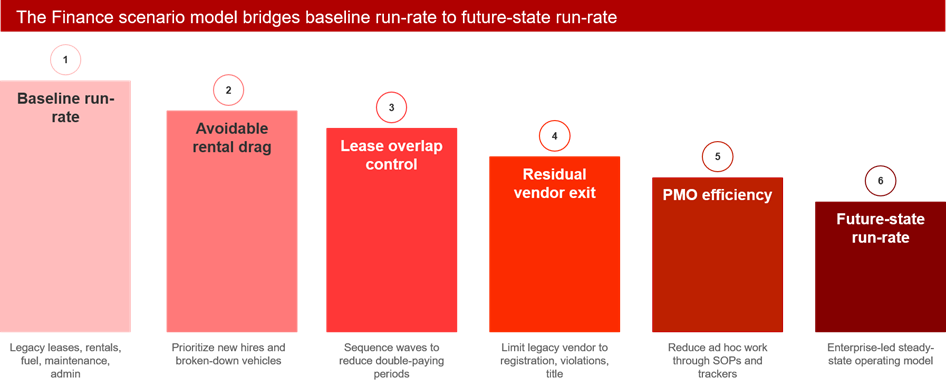
The project delivered:
The single-desk PMO gave our client one place to manage the full transition. This helped prevent fragmented vendor conversations and created a clear escalation path.
Sequencing the transition by operational risk helped protect the driver experience and gave the team space to manage exceptions before they scaled.
Clear FAQs, wave-based messaging, and response templates helped reduce uncertainty for the field and lowered avoidable ticket volume.
The project did not end with a knowledge-transfer meeting. It ended with documented processes, decision rules, trackers, and support tools that could be used by the receiving team.
Fleet vendor transitions are not just procurement projects. They are live operating model transitions with a mobile user base and no downtime tolerance.
For organizations managing similar transitions, four lessons stand out:
Whether the goal is to transition vendors, redesign an operating model, or stabilize a complex cross-functional program, we help clients turn change into practical execution.
Our teams combine hands-on delivery, structured governance, and relevant expertise to help organizations move from decision to implementation with confidence.
The team

Nishit Bhuva
Client Service Partner Princeton


Leanne Collinson
Talent Service Partner London
Suggested Case Studies




Register for our newsletter to receive curated insights directly to your inbox.